The client has not approved and the post is due: publish, hold or skip?
It is Thursday evening, the post goes out at nine tomorrow, and the client has read your message and said nothing. Here is how to decide what happens next, once, instead of every Thursday.
Rodolfo MotaFounder of SPREVA
The short version
When a client has not approved a post by its time, hold it. The post goes out under their name, and a wrong price is theirs to explain. Silence is not a yes, even when a contract says so. Agree on an approval deadline before the first post, make it visible while there is still time, and let a missed deadline move the post, not publish it.
Why the client says nothing
A client not responding is rarely a client saying no. The owner of a café sees your message at seven, while the oven heats, and means to answer after the morning rush. The rush ends at three. The post was due at nine.
Silence is the default because nothing in the request says what silence leads to. “Could you look at these when you have a minute?” has no deadline, so it loses to everything that has one. A good social media approval process is mostly a request that carries its own deadline.
Publish, hold or skip
When the time comes and the answer has not, there are four ways to go:
- Publish anyway. The calendar stays full and the risk moves to the client's account. If the post carried last month's price, you published it.
- Publish under a clause. The contract says a post counts as approved unless the client objects in time. The post still goes out unseen.
- Hold until approved. The post waits and goes out at a new time once the client says yes. A day is lost, and nothing goes out unseen.
- Skip it. The post goes back to the drafts. Right for anything tied to a date that passes: a lunch special, a weekend event.
“Approved unless you object” keeps the calendar moving. On the day a post is wrong, with a price that changed or a photo of someone who has left, the clause settles whose fault it was. It does not take the post down, and it teaches the client that reading is optional.
Choosing by client and by kind of business
What changes from client to client is not whether a post waits for a yes. It is how early you send it and whether a post that is not approved in time moves or is dropped, which depends on what a wrong post would cost.
A dental clinic or a pharmacy works under rules about what it may say in public: send its posts a week ahead, and drop one that is not approved in time rather than rush it. A café can see the week's posts on Monday morning, and one that is not approved in time simply moves. Whatever you choose, write it down for each client.
Words for the contract and the first meeting
A rule works when the client heard it before the first post, not after the first missed one. Put it in the contract in plain words, with your own numbers:
Approval. We send each post for your approval at least two working days before it goes out, with its planned day and time. A post goes out only once you approve it. If a post has no answer by its time, it does not go out: we tell you and agree a new time. A post tied to a date that passes while it waits is dropped.
In the first meeting, ask who approves, by name, and who approves when that person is away. A café whose owner takes August off needs a second name in July.
Make the deadline visible before it passes
Most missed approvals are a deadline nobody could see. Put it in the request: when the post goes out, in the client's own time, and what happens if no answer comes. The reminder the day before says it plainly:
Hi Ana, the post about Saturday's tasting goes out tomorrow at 9am and still needs your answer. If it is not approved by then, it does not go out, and we will ask you for a new time.
Send it a day before, not an hour before, so the client can answer the next time they look at their phone. When the deadline passes, do what the message said, or the next deadline is only a suggestion.
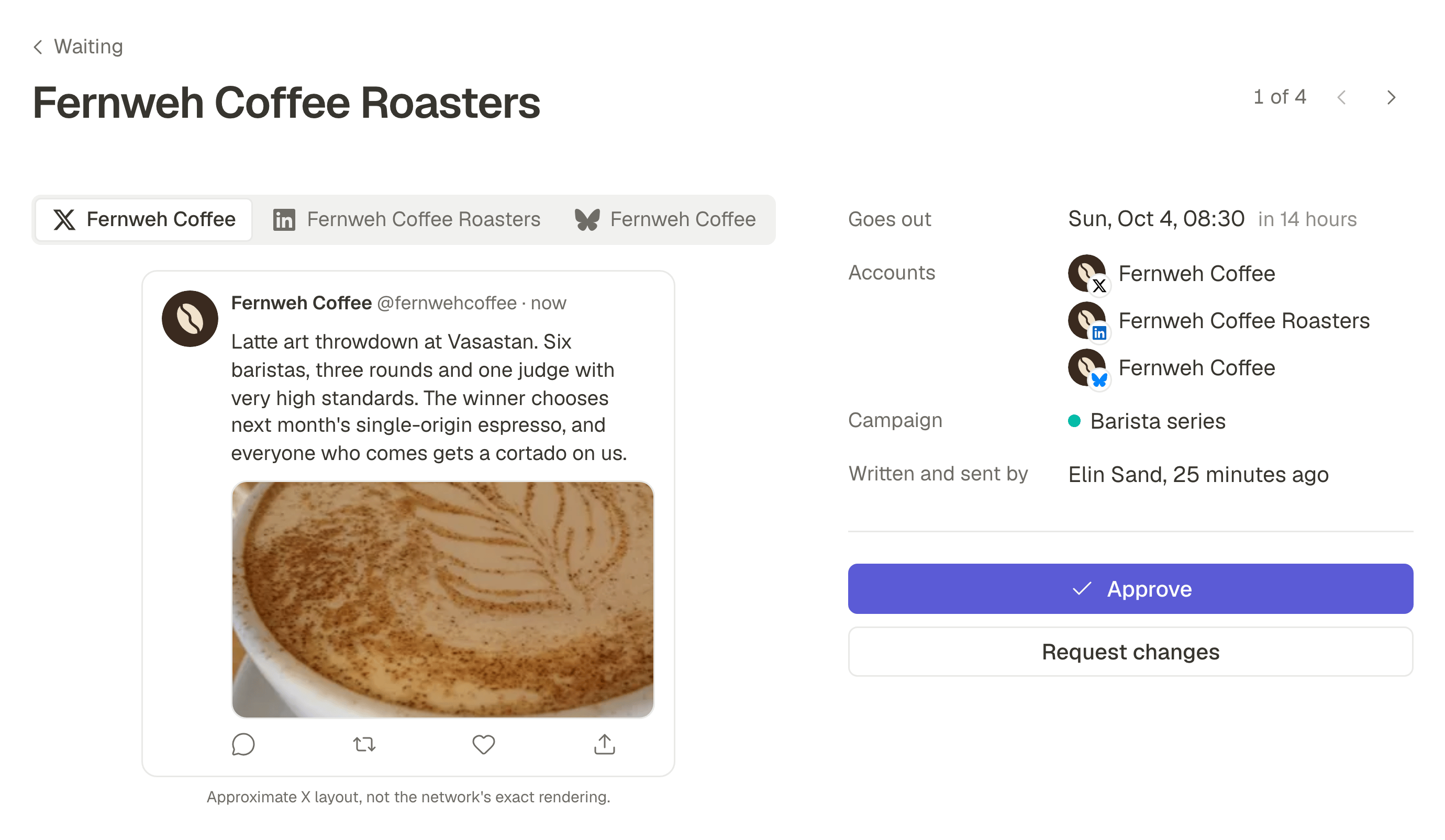
Let the deadline hold the post
In SPREVA, holding is a setting. With approval on, a post nobody approved by its time is not sent: it becomes a draft again and its author is told. Reviewers are free on every plan, up to 25 per workspace, and every plan starts with a 7-day trial. How required approval works.
Questions
Is it ever right to publish a post the client has not approved?
Not by default. If a client wants some posts to go out without their answer, have them name which kind in writing, and keep prices, offers and dates out of it.
How much notice should a client get?
Enough to answer without stopping their day: two working days for most small businesses, a week for posts checked against rules.
What if the client is never on time?
Change the rhythm, not the rule: send the week's posts on Monday morning, remind them on Wednesday, and agree who approves when they cannot.
Can SPREVA publish a post when the client does not answer?
No. A post waiting for approval is not sent if nobody approves it in time: it goes back to its author as a draft. How client approval works in SPREVA.
Written by
Rodolfo Mota
Founder of SPREVA
Makes SPREVA in Portugal: the Studio, the tools an agent works with, and the publishing behind them.
Keep reading
- The client never approved it, and it went out anywayA time moved, a caption fixed after the yes, a post scheduled in a hurry. How posts go out unapproved, and how SPREVA makes every post wait for a yes.
- How to get a client to approve posts from their phoneClients drop tools that want a password and a seat. How a client approves posts from a phone in SPREVA: one email, a sign-in link, each post as it will look.
- “That is not what I approved”: what to show the clientA thumbs-up in a chat is weak proof when a client disputes a post. What an approval record should hold, how SPREVA keeps one, and how to use it calmly.